Finance Workflow Automation
CompletedClient project: Automating a Shopify merchant's finance reporting
Starting Point
A Shopify merchant was spending about 40 hours per month on B2B client reporting. The reporting was almost entirely manual, with around twenty intermediate steps, cells were color-coded depending on the processing stage, each month's starting point had to be found manually, and the processes involved a lot of copy-pasting.
Additionally, the accountant needed a complex shipping cost report for each client. Their existing Excel system was producing incorrect results and causing additional manual work.
Why This Was a Problem
Beyond the wasted time, constant errors, and reporting delays — which in turn delayed payments — the existing system simply didn't scale.
How I Approached the Problem
I mapped the current state, spoke with the finance team and accountant about the existing system's challenges and what caused the most slowdowns. It was especially important to understand the desired end result, because the more I understood the current processes, the clearer it became that merely tweaking them wouldn't produce the change we needed.
What Changed in the Processes
After mapping the current processes, data sources and their accuracy, and the desired outcomes, I decided what needed to change. This included handling product returns within a given reporting period and changing the reporting period to exactly one calendar month.
How I Arrived at the Solution
Excel couldn't handle the required processes. Existing SaaS solutions would have needed heavy customization at best, and the company didn't have an ERP in place. A custom Python automation was the right-sized, flexible solution — and one I was already familiar with.
What I Automated
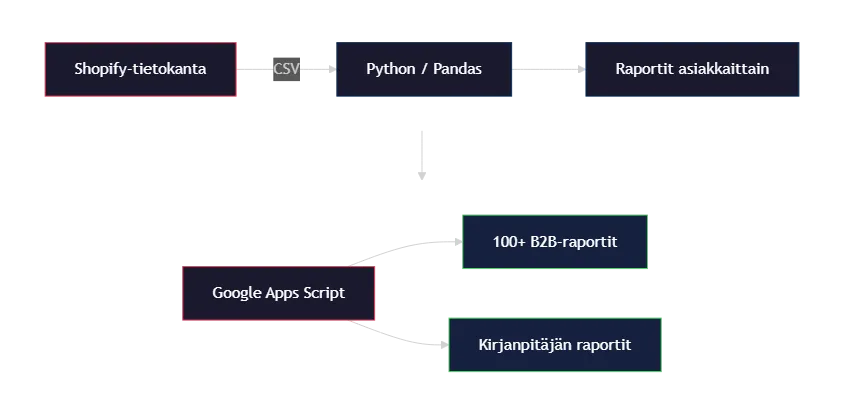
Nearly everything. When the project was complete, the only manual step was downloading CSV files from the database for a given month. After that, they could be uploaded through a simple graphical interface. B2B client reports were wanted as Google Sheets with specific formatting, so I developed a Google Apps Script that converted the CSVs into Sheets and handled the formatting for all 100+ reports at once.
Result
40h/month+ freed for business development. The entire process of creating 100+ reports for as many clients, plus accountant reports, now took about 2 hours including review — and reporting errors stopped, which also reduced stress.
Technical Details
A Python script (pandas) processes the Shopify data, Google Apps Script handles report formatting in Sheets.
What I Learned
When there are multiple stakeholders and a complex process, documentation solves more problems than code. The agreed-upon end result and test data must exist before writing a single line of code.